
When performance problems show up in React, the first instinct is often to grab
React.memo, useCallback, or useMemo. These APIs are powerful, but they do
not prevent renders. They only try to make a render cheaper after it already
happened.
This article argues for a simple ordering:
- Fix component structure and state placement first.
- Reach for memoization only when measurements prove it is worth the trade-off.
Why memoization is not the first fix
React.memo
React.memo skips a render only if the props are referentially equal to the
previous render. That means React compares props on every render. That comparison
has a cost, and it breaks easily when you pass new object/array/function
references.
This does not mean you should avoid memo entirely. It is excellent for:
- Heavy, expensive components.
- Components that re-render because of frequent parent updates.
useCallback
useCallback does not prevent re-renders. It memoizes a function reference so
referential equality stays stable when you pass callbacks to memoized children.
Trade-offs include:
- Dependency arrays add complexity.
- It is easy to create stale closures.
- Often useless unless paired with
React.memo.
// Example of a stale closure
const increment = useCallback(() => {
  setCount(count + 1);
}, []); // Empty deps = potential stale closure
useMemo
useMemo memoizes a calculated value, not a component. It is frequently
overused.
Common issues:
- Memoization itself has overhead.
- Cheap calculations are often faster to recompute.
- Incorrect dependencies can cause stale values.
- It becomes a "performance placebo."
The shared limitation
All memoization hooks share a key limitation:
- The component is still in the render tree.
- React still needs to do work.
- You pay either render cost or comparison cost.
The better question is: Why is this component rendering at all?
Component composition: the cheapest optimization
The most effective optimization is not rendering a component in the first place. You get that by:
- composing components thoughtfully,
- colocating state near where it is used,
- and avoiding large "god components."
Try the example below locally or on CodeSandbox.
function App() {
  const [count, setCount] = React.useState(0);

  console.log("App render");

  return (
    <div>
      <button onClick={() => setCount((c) => c + 1)}>Increment</button>
      <ExpensiveComponent />
    </div>
  );
}

function ExpensiveComponent() {
  console.log("ExpensiveComponent render");
  return <div>I am expensive</div>;
}
Output after clicking "Increment":
App render
ExpensiveComponent render
What happened?
The count state lives in App. When it changes, App renders. React then
renders all its children, including ExpensiveComponent, even though it did not
change.
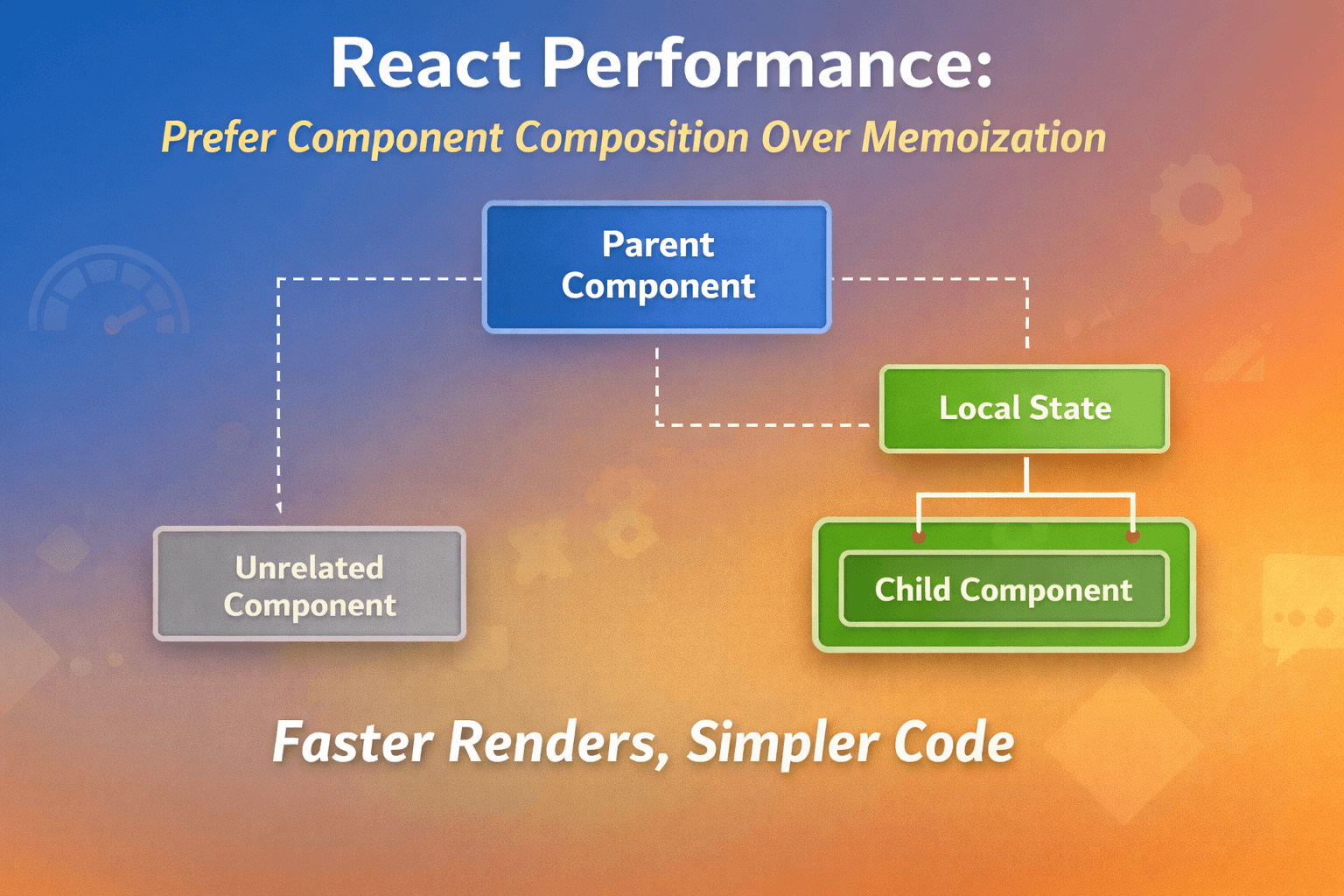
Fix it without memo
Move state down into a smaller component:
function Counter() {
  const [count, setCount] = React.useState(0);

  console.log("Counter render");

  return <button onClick={() => setCount((c) => c + 1)}>Increment</button>;
}

function App() {
  console.log("App render");

  return (
    <div>
      <Counter />
      <ExpensiveComponent />
    </div>
  );
}

function ExpensiveComponent() {
  console.log("ExpensiveComponent render");
  return <div>I am expensive</div>;
}
Output after clicking "Increment":
Counter renderWhy this scales better
- The state is scoped to
Counter. Counterre-renders, butAppdoes not.- Siblings like
ExpensiveComponentare skipped entirely.
Principle: the fastest component is the one that never re-renders.
Summary
Memoization is valuable when used intentionally, but it should not be your first response to performance concerns. Most real-world problems are structural:
- component hierarchy,
- state placement,
- and unnecessary shared parents.
Start with composition. Add memoization only when profiling shows it is needed.
What is next
In the next article, we will go deeper on:
- when lifting state up is necessary,
- how to avoid unrelated re-renders in shared state,
- and when memoization is justified (and when it is still the wrong tool).